Showing posts with label 19th Century Fashion. Show all posts

Sunday, January 26, 2014

Upcoming Lecture Series: The Social History of Dress in 19th Century Canada


Do you have some old family photographs but don’t know when they were taken? Do you know some of the major fashion innovations and stylistic changes in the 19th century that can be of help in dating old photographs?

If you want to learn more, please join me for this two-part lecture series at the North York Central Library branch in Toronto. This course is intended as a primer on the social history of dress seen in 19th century photographs from the Victorian age to the Edwardian age, with a special emphasis on Canadian history.

Victorian photography offers a glimpse into another time. Not long after photography was invented in 1839, the medium allowed families and individuals to preserve their likeness in a matter of minutes. For the first time in history, all classes of society could stop time, preserving the reflected light of their image for generations to come. These images are embedded with clues related to codes of dress and behaviour marking them as mirrors of their age.

The lectures will be illustrated and there will be handouts.  Weather permitting, I hope to bring in a small selection of 19th century artifacts, such as fashion journals, garments and accessories, as well as examples of Victorian photographs including a daguerreotype, tintype, carte des visites, and cabinet cards. To close, there will be a discussion on best practices for the care of old photographs and extant garments to assist with preserving precious family artifacts.

The lectures will be held on Tuesday, February 18th and 25th from 2-4 pm.

Advance registration is required. For further information, email courses@torontofamilyhistory.org or visit the Ontario Geneological Society website.


Saturday, April 21, 2012

Art, Fashion and La Parisienne

Exhibition poster designed by Ingrid Mida 2012
I've been quiet on the blog front of late, because I've been deep into my research for my thesis, which I hope might one day become a book. I created these two posters to illustrate my project which is entitled Art, Fashion and La Parisienne

My work was inspired by a painting called La Demoiselle de Magasin (The Shopgirl) by James Tissot which is in the collection of the Art Gallery of Ontario. I soon discovered that this painting was one of fifteen large scale works in a series called La Femme à Paris painted by Tissot in 1883-85. Tissot made plans to issue series of etchings of the paintings, which were to be accompanied by short stories by leading authors of the period, including Émile Zola, Paul Bourget, Charles Gounod, and Alphonse Daudet. Despite Tissot’s earlier success as a painter, this series of highly polished paintings was not well received in either Paris or London. Tissot abandoned his plans to create prints of the paintings and the accompanying short stories.


La Femme à Paris  is a provocative series of narrative works showcasing the modern Parisian woman during a period of rapid change in the nineteenth century.  The series illustrates women from a range of income levels and occupations, rendered in precise detail using high key colours.

During the latter part of the nineteenth century, fashion and art were closely linked in Parisian society. Fashion was a subject of study and inspiration for artists, playwrights and poets. Descriptions of outfits worn by society women to the theatre, the opera and other social gatherings were routinely reported in the press. Many artists in France were influenced by the writings of Charles Baudelaire on fashion and modernity, especially his essay “The Painter of Modern Life” which was published in instalments in 1863 in the newspaper Le Figaro. In this essay, Baudelaire identified fashion as a way that artists could capture the processes of modernity in their work.

Using James Tissot’s series La Femme à Paris from 1883-85 as inspiration, my research will encompass an analysis of a selection of artworks, fashion plates and gowns from 1874-1886 to illuminate the intersection of art, fashion and modernity in the theme of la Parisienne.

I'm heavily immersed into my research, and I find the work utterly captivating. I now understand the origins of the modern icon of la chic Parisienne, images of which regularly grace the pages of blogs like French Essence, Fashion, Art and Other Fancies, Style in the City and of course, The Sartorialist.  

Although my blog posts might be a little less frequent, you can also find me on Pinterest, Facebook or Twitter.


Notice of copyright: 
All text and images on this blog are the copyright of Ingrid Mida, unless otherwise noted. The copying of posts, images and/or text without proper attribution is violation of copyright and legal action will be pursued.

Tuesday, April 5, 2011

Cartes des Visite and Fashion History

White has been the choice of most brides since the time of Queen Victoria's wedding to Prince Albert in 1840. But surprisingly other colours such as black, blue or brown were also worn in the 19th century by brides who favoured a more practical choice of gown to be worn again. 

From the Halmrash studio, 529 Washington Avenue South, Minneapolis

In this particular photograph, the bride is wearing a dark gown, probably dark blue or black silk. Undated, it took a bit of sleuthing to date this photograph.  

In the Victorian era, collecting cartes de visite of friends, family and prominent persons was a popular pastime. These small  2⅛ × 3½ photographs were supplanted in the early 1870s by the larger sized "cabinet cards" which measured  4½ by 6½ inches. Cabinet cards remained popular into the early 20th century when Kodak introduced the Brownie camera. When I see a tray of cartes de visite or cabinet cards in an antique market, I am compelled to bring them home. Once I bought so many that the vendor asked me if I was buying a family. What I'm actually buying is a bit of fashion history. 

The bride is wearing a black, blue, or brown dress with long sleeves and a high collar with white piping detail and white buttons for the collar opening. The bodice is slim fitting and appears to be a type of corset overlay with two rows of white buttons. The skirt seems to be softly draped across the front and has a small ruffled hem. Her white veil is sheer and to the floor with flowers or other ornament as a type of tiara. 

How would a historian date this dress?

The image is a larger cabinet card for a starting point of at least 1870. But the absence of a bustle suggests that it must be later than 1880. And since the sleeves are not overly extreme in shape as was common in in the mid-1890s, I'm guessing that this dress would be dated somewhere between 1898-1903.

To check, I went to the Victoria and Albert Museum website which offers a treasure trove of information on historical dress and discovered that they have a database of wedding photos. There is a similar style of dress worn by Sarah Poortvliet in her marriage to Fobbe William Hoekstra dated February 14, 1901. How cool is that?

Wednesday, March 9, 2011

Out of the crate: Fashioning Fashion at LACMA

Timeline Installation photo by Ingrid Mida 2011
There are only a matter of weeks left to see The Fashioning Fashion exhibition at the Los Angeles County Museum of Art. This extraordinary display of garments and accessories spanning 1700 to 1915 is unparalleled in its importance to fashion history due to its breath, its quality and the excellent condition of the pieces. Included in the nearly 160 examples of fashionable dress, undergarments and accessories are a number of extremely rare pieces. And while the exhibition catalogue Fashioning Fashion illustrates each and every garment in the collection in lavish photographs, there is really nothing like being there to fully appreciate the workmanship in these garments and accessories.

Timeline Installation Photo by Ingrid Mida 2011
This collection was purchased in its entirety from two dealers who had each separately amassed collections of historic textiles and dress for more than 25 years. They wanted their combined collection go to a single museum. Director Michael Govan said "After seeing these rare objects, it was clear that we should bring the collection to Los Angeles, as my first major collecting initiatives after arriving at LACMA. This acquisition has catapulted the museum's holdings of European costume to the highest category of quality."


Lady's chemise, panier and corset 1750-1780 LACMA
Photo by Ingrid Mida
The heavy gray box-like structures displaying the garments initially seemed to detract from the delicate beauty of the garments on exhibit. But then I recognized the allusion to the garments emerging from shipping crates. The "crates" are painted gray like the neutral backdrops that costumes are typically photographed against in a museum. Raised up on platforms, the crates elevate the displays to allow easy viewing by all. And on occasion, their layout allows a playful peak at what is yet to come. Close to the ceiling of the gallery, the red lettering of the FashioningFashion labels add a punch of colour to the cavernous space and seem to reference the red steel beams of the building directly across from the Resnick Pavilion. In the end, I concluded that the contrast of the modern installation with the historic fashion pieces was a very clever thing to do and oh so LA.

Tailoring installation, LACMA photo by Ingrid Mida 2011
The white mannequins and paper wigs create neutral forms which focus the viewer's attention on the clothes and not the carrier, although some of the garments are suspended by wires with invisible mannequin forms (another allusion to modernity perhaps?)

Men's Waistcoats 18th century France, LACMA Installation photo by Ingrid Mida 2011
Normally it is easy for me to pick out a favourite garment from an exhibition but this time I fell in love with all of it. The extraordinary workmanship and beauty of the garments on display make it impossible to choose just one. So rare is it that a museum puts its entire collection on display that this is a once in a lifetime event.  I hope it stays burned into my memory.

Fashioning Fashion: European Dress in Detail, 1700-1915
Closes March 27, 2011
Los Angeles County Museum of Art
5905 Wiltshire Boulevard
Los Angeles, CA, 90036
323-857-6000

Thursday, February 17, 2011

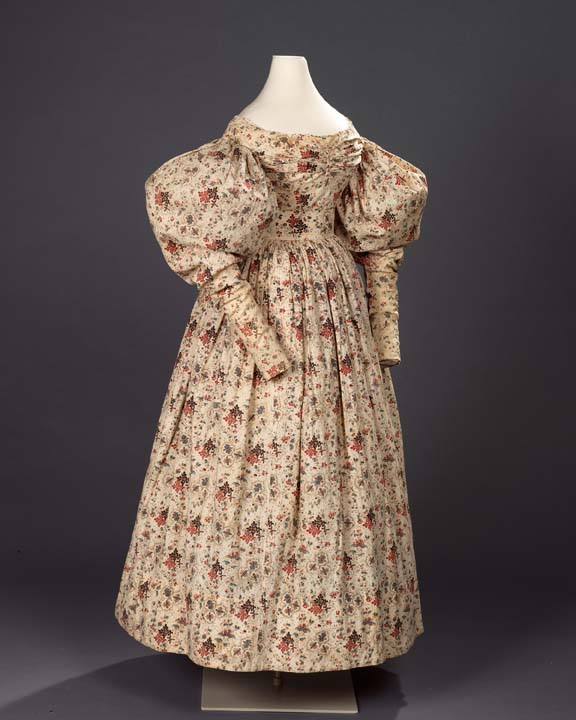
19th Century Day Dresses

Woman's day dress, USA c.1826-1834
ROM 975.241.18 A-B (Gift of Mrs. Henry P. Kendall)
Photo by ROM Staff under copyright

In "Striking and Innovative Printed Fashions in the 19th Century" at the Royal Ontario Museum's Patricia Harris Gallery of Textiles & Costume, a selection of beautiful 19th century day dresses are currently on display. In the photo above, a woman's cotton day dress and belt (c.1826-34) illustrates the 19th century technical innovations achieved in printing fashionable textiles. According to Dr. Alexandra Palmer, senior curator, the "inventive manufacturers enticed consumers by combining hand and mechanical printing techniques, thereby creating new colours and patterns. The resultant fashions using the latest scientific inventions in textile production clearly signified modernity."


19th Century Dresses on display at the ROM
Photo by Ingrid Mida 2011

The display at the ROM includes these printed cotton gowns from the 19th century as well as charming examples of children's wear of the time.

According to the chapter Of the Choice of Clothing in the book The Lady's Stratagem, there were very defined rules for what was considered fashionable and appropriate attire in the 19th century.

"When at home, you should always be dressed neatly and respectably enough to go out or visit your friends without having to put on any thing except your gloves, shawl and hat; but dress without any affectation. If you clothing is over-trimmed or appears to hamper daily occupations, it might perhaps be even more ridiculous than if it were too common. Wear pretty prunella shoes; very white cotton stockings; a gown of gingham, a beautiful calico, or merino according to the season, suitably trimmed; a belt without ribaund loops; a collerette or fichu de lingere; a very neat coiffure en cheveux; and finally, if you have a great deal to do, a black silk apron. Such is the costume which is proper for a woman in her home. Gowns of silk, muslin, and other such materials, unless you have a very considerable fortune, bespeak vanity and indolence. In my opinion, a young woman's attire should be a constant testiomy of modesty, order and industry." (page 186)


Tuesday, November 23, 2010

The Meaning of Clothing

"Clothing is to the body what education is to the mind. Clothing consists of similar elements for everyone, yet it varies according to the taste, attitude, order, care, elegance, and distinction everyone brings to it."
                                               Comtesse de Bassanville, Paris, 1859


Portrait of the Empress Eugenie dressed as Marie Antoinette by Franz Xaver Winterhaller, 1854, oil on canvas
(The Metropolitan Museum of Art, New York City)
In the book Fashioning the Bourgeoisie, Phillipe Perrot compares the origin of clothing with the origin of language, both defined by vast unknowns and complexities. Both clothing and language happen "somewhere in geographical and social space." And while the purpose of clothing is typically thought to be protection, modesty and adornment, the variety of body coverings across time and cultures refutes that. He cites the example of the natives of Tierra del Fuego who remain nude to hunt in the snow.

Perrot asserts that it is "through dress that groups and individuals give themselves meaning." For example, articles of clothing like the equestrienne styled blazer or yoga pants, that originally served functions for hunting or sport, are worn today to signify other qualities like an aristocratic aura or sportiness.

"Sign or symbol, clothing affirms and reveals cleavages, hierarchies, and solidarities according to a code guaranteed and perpetuated by society and its institutions." (page 8, Fashioning the Bourgeoisie). Consider the elaborate dress codes of the 19th century in which lace and feathers were forbidden before noon and decolletage, too-ample skirts or showy jewels were in bad taste before evening. And women of a certain age had to forego "bright colors, elegant designs, the latest fashions, and graceful ornaments such as feathers, flowers and jewels." Stepping outside of these dictates left one subject to ridicule and scorn.

It seems to me that with the exception of a few professions like bankers and judges, and perhaps a few formal occasions like weddings, dress codes seem to have been largely abandoned. And even though almost anything goes, clothing still  signifies status and identity. The clues are a lot more subtle, manifesting in cut, quality of textile, fit and also in accessories, especially shoes and handbags. Perhaps that is why prestige labels are so coveted.

Saturday, November 20, 2010

Book Review: Fashioning the Bourgeois


If you have a a deep and abiding love of costume history and are able to find this book on the shelves of a library or in a book bin somewhere, don't hesitate to pick it up. It offers a fascinating analysis of the development of fashion in the nineteenth century, incorporating extensive quotations from primary sources of the period. Translated from the French, it is, in parts, dense and scholarly but well written and really quite accessible to both scholars and fashion history aficionados alike.

When this book was first published in 1981 under the original French title Les Dessus et les Dessous de la bourgeoisie, the author Philippe Perrot exploded the myth "that it is futile for historians to study things that seem inconsequential and trivial" like fashion. Most intellectual work on clothing had been to that point done by sociologists or economists. This book lay the groundwork for a body of "cross-disciplinary historical study that is based on the assumption that few, if any, human artifacts are without meaning, in that they are first created by humans and then more-or-less profoundly shape the way we live".  (pg xii of the Preface by Richard Bienvenu).

Fashioning the Bourgeoisie is divided into eleven chapters:
I. Toward a History of Appearances
II. Clothing's Old and New Regimes
III. The Vestimentary Landscape of the Nineteenth Century
IV. Traditional Trades and the Rise of the Nineteenth Century
V. The Department Store and the Spread of Bourgeois Clothing
VI. New Pretentions, New Distinctions
VII. The Imperatives of Propreity
VIII. Deviations from the Norm
IX. Invisible Clothing
X. The Circulation of Fashions
XI. Conclusion

For me, the first chapter - which is on the meaning of clothing - resonated very deeply as I seek to understand the role of fashion in my art practice. Chapter VII on The Imperatives of Propriety is likewise bewitching in the detailed descriptions of the minute requirements for a fashionable woman's wardrobe. Invisible clothing, chapter IX, reveals the history of undergarments, including the corset and crinoline.

If I only owned one book about the 19th century, this would be the one.  Many of the things we take for granted - the availability of ready to wear clothing, the existence of department stores, the emergence of the fashion designer, and differentiation in dress - are rooted in the technical, industrial, commercial and social innovations that happened in the 19th century. I only have this book for a few more days before it has to go back to the stacks of the Robarts Library at the University of Toronto.

P.S. Since writing this post, a reader pointed out that this book is actually available on Amazon. I'm not sure why I didn't check first. The library copy I have is so very old that I assumed it was out of print.

Wednesday, October 20, 2010

Fashioning Fashion at LACMA


This exquisite embroidered French evening mantle c.1891 graces the cover of the sumptuous book "Fashioning fashion: European Dress in Detail 1700-1915". Published in conjunction with the inaugural exhibition by the same name, this catalogue presents nearly two hundred items from the Los Angeles County Museum of Art's recently acquired European costume collection. The book is filled with glorious colour photos of the costumes along with numerous detail photos of the luxurious textiles, exacting tailoring techniques, and lush trimmings used during this period.  

Curated by Sharon S. Takeda and Kaye D. Spilker of LACMA, the Fashioning fashion exhibition presents over 160 examples of European fashionable dress, undergarments, and accessories covering the period 1700-1915. This collection of clothing and accessories was acquired several years ago and many items are being exhibited for the first time. The exhibition is organized into four thematic sections—Timeline, Textiles, Tailoring, and Trim.

Timeline presents a chronological look at both men's and women's fashions. The women’s visual timeline is illustrated with dresses in various shades of white to focus attention on the evolving fashionable silhouette. The men’s timeline begins with luxurious and colorful examples of eighteenth-century aristocratic men's dress and concludes with a subdued 1911 pinstripe suit, a style that has remained relatively unchanged for a century.

Installation view, Fashioning Fashion: European Dress in Detail, 1700-1915.
Photo: © 2010 Museum Associates/LACMA.
Textiles are often the most expensive component of fashion and this section presents an assortment of textiles—from silk to cotton, gauze to velvet, plain to printed. The choice of fabric - medium, weight, colour and pattern - all affect how fashion is fashioned. 

Tailoring explores the manipulation of textiles through cutting, stitching, and padding in order to create the idealized shape or fashionable silhouette of each era. With the advancement of tailoring tools and techniques, styles were able to change in dramatic ways, accentuating or minimizing different body parts.

Trim celebrates the artistry of embroiderers, quilters, and lace makers, especially in the highly embellished garments from the eighteenth-century 

Fashioning Fashion examines the transformation of fashion over a period of more than two centuries, and adds contextual commentary to show how political events, technical inventions, and global trade profoundly affected style. This is  one of the three exhibitions opening LACMA’s new Lynda and Stewart Resnick Exhibition Pavilion, a 45,000-square-foot building by Pritzker prize-winning architect Renzo Piano. The installation was designed by renowned opera stage designers Pier Luigi Pizzi and Massimo Pizzi Gasparon.

If you cannot get there before the exhibition closes on March 27, 2011, I suggest you buy the book. You won't be disappointed. It is one of the most beautiful fashion books I've ever seen (and I own a lot of books!). And even John Galliano, who wrote the preface, said "Fashioning Fashion takes you through fashion and time with the sumptuous variety of an extraordinary collection. I promise, it cannot fail to inspire you."

Author: Sharon Sadako Takeda and Kaye Durland Spilker
Published by: Delmonico Books: Prestel (New York) 2010 
Category: Non-fiction, costume history
Number of Pages: 224

Los Angeles County Museum of Art • 12-8 M/T/Th • Closed Wednesday • 12-9 F • 11-8 S/S
5905 Wilshire Blvd • Los Angeles California 90036 • 323-857-6000 • publicinfo@lacma.org


Friday, October 9, 2009

Symbolism of the Crinoline


Fashion historians have ascribed different meanings to the enormous skirts of the mid-19th century, which was a period of significant male domination and gender differentiation. Men were considered "serious, active, strong and aggressive" and wore dark clothes with little ornamentation. Women were "frivolous, inactive, delicate and submissive" and wore clothing that inhibited their movement in light pastel colours, ribbons, lace and bows. In one sense, the crinoline symbolized female fertility like all fashions that expand the apparent size of the hips. In another aspect, the huge bell like skirt concealed women's sexuality in a cage and created a form of female imprisonment.

Other fashion historians have asserted that the crinoline was representative of how the bourgeois women adopted a "useful cloak of armour" to mediate the experience of modern city life. The enormous width of the skirt provided a barrier between the wearer and everyone else. This was important in a time in which increasing urbanization and industrialization led to more frequent contact with strangers. In that sense, the crinoline was a modest form of "protection".

In spite of being much maligned in the press, the mass manufacture of the cage crinoline became an important industry and the largest firm W.S. and E.H. Thomson had factories in England, France, Germany and the United States. Technical advances reduced the manufacturing costs and brought crinolines within the reach of all social levels.

As the popularity of the crinoline grew, it began to lose appeal among the fashionable set as they sought to differentiate themselves from the working class. In the mid-1860s, the crinoline began to shift to the back of the skirt, leaving the front skirt panel more or less straight. By 1868, the reinforcement of the skirt had slipped entirely to the back becoming a half-crinoline. By 1870, the crinoline disappeared altogether and was replaced with the bustle.